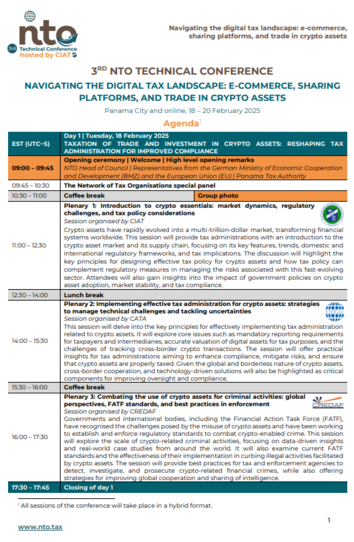
Programme of the 3rd NTO Technical Conference
Download English Download Spanish Download French February 2024
Programme of the 3rd NTO Technical Conference Read More »
Download English Download Spanish Download French February 2024
Programme of the 3rd NTO Technical Conference Read More »
Download English Download Spanish Download French February 2025
Brochure for the 3rd NTO Technical Conference Read More »
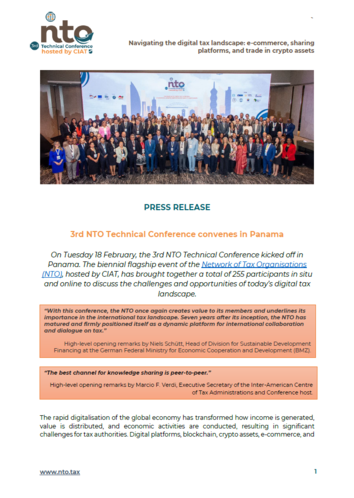
Download English Download Spanish Download French February 2025
3rd NTO Conference Press release (EN,ES,FR) Read More »
Download English Download Spanish Download French September 2023
2nd NTO Technical Conference – Brochure Read More »
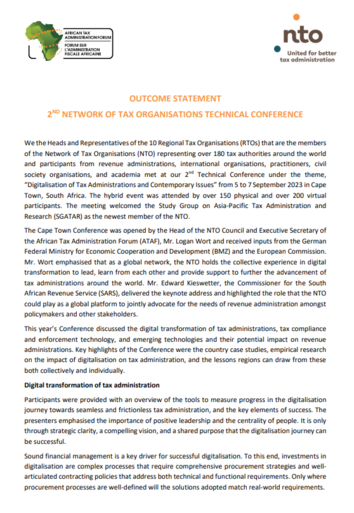
Download English Download Spanish Download French September 2023 OUTCOME STATEMENT 2ND NETWORK OF TAX ORGANISATIONS TECHNICAL CONFERENCE We the Heads and Representatives of the 10 Regional Tax Organisations (RTOs) that are the members of the Network of Tax Organisations (NTO) representing over 180 tax authorities around the world and participants from revenue administrations, international organisations, practitioners, civil society organisations, and academia met at our 2nd Technical Conference under the theme, “Digitalisation of Tax Administrations and Contemporary Issues” from 5 to 7 September 2023 in Cape Town, South Africa. The hybrid event was attended by over 150 physical and over 200 virtual participants. The meeting welcomed the Study Group on Asia-Pacific Tax Administration and Research (SGATAR) as the newest member of the NTO. The Cape Town Conference was opened by the Head of the NTO Council and Executive Secretary of the African Tax Administration Forum (ATAF), Mr. Logan Wort and received inputs from the German Federal Ministry for Economic Cooperation and Development (BMZ) and the European Commission. Mr. Wort emphasised that as a global network, the NTO holds the collective experience in digital transformation to lead, learn from each other and provide support to further the advancement of tax administrations around the world. Mr. Edward Kieswetter, the Commissioner for the South African Revenue Service (SARS), delivered the keynote address and highlighted the role that the NTO could play as a global platform to jointly advocate for the needs of revenue administration amongst policymakers and other stakeholders. This year’s Conference discussed the digital transformation of tax administrations, tax compliance and enforcement technology, and emerging technologies and their potential impact on revenue administrations. Key highlights of the Conference were the country case studies, empirical research on the impact of digitalisation on tax administration, and the lessons regions can draw from these both collectively and individually. Digital transformation of tax administration Participants were provided with an overview of the tools to measure progress in the digitalisation journey towards seamless and frictionless tax administration, and the key elements of success. The presenters emphasised the importance of positive leadership and the centrality of people. It is only through strategic clarity, a compelling vision, and a shared purpose that the digitalisation journey can be successful. Sound financial management is a key driver for successful digitalisation. To this end, investments in digitalisation are complex processes that require comprehensive procurement strategies and well-articulated contracting policies that address both technical and functional requirements. Only where procurement processes are well-defined will the solutions adopted match real-world requirements. The discussions emphasised that digitalisation should be viewed as the driver of change rather than the change itself. Too often authorities identify technologies they want to adopt rather than the problem or process that can be resolved or enhanced. Importantly, the meeting recognised the varied levels of digitalisation in different jurisdictions. We unanimously sighted collaboration of the members of NTO as critical in supporting each other to achieve digitalisation faster. Tax compliance and enforcement technology The Conference highlighted the transformative role of technology in reshaping tax compliance, spotlighting the efficiency, and empowerment brought about by e-filing and modern data collection methods. To truly empower taxpayers, administrations must harness data, focusing on its integrity, and converting it into actionable strategies through data science and engineering. Emerging technologies and their potential impact on revenue administrations New technologies present opportunities for tax authorities to improve data management and analytics, resulting in improved detection of non-compliance and increased efficiency in tax administration. The success of the application of new technologies is dependent on high-quality data, and an entrenched data culture and literacy within authorities. The Conference deliberated on the need for tax officials to expand their skills to include an understanding of dynamic business models, technological competence, and data savviness, in addition to traditional tax administration and audit skillsets. During the closing session, the NTO Council: Conveyed its appreciation for the support provided to the NTO Secretariat by the BMZ/European Union Commission and NTO members committed to working on the development of its future. Expressed the need for, and committed to closer cooperation, complementarity, and collaboration between NTO members. Acknowledged and appreciated the work being done by other international tax organisations and pledged that the NTO will work closely with these organisations in the fulfilment of its mandate. In this regard, the Council reiterated the need for enhanced coordination of activities and regular consultations between the NTO and these organisations especially in the area of capacity building in order to avoid potential duplications of roles and activities and thus ensure optimal use of resources. Delegates expressed the need for closer cooperation between tax authorities of all countries as well as the need to share knowledge and experiences. They called on the NTO to play a role in international cooperation in the digital transformation of tax administrations and to enhance its work across the tax spectrum to support the work of its member RTOs. Finally, we are very grateful to ATAF for having hosted the 2nd Technical Conference and we look forward to future engagements. Executive Secretaries and Directors of the ten NTO member organisations and some keynote speakers at the NTO Conference © GIZ
Outcome Statement of the 2nd NTO Technical Conference Read More »
Download English Download Spanish Download French July 2019 In this position paper, the Network of Tax Organisations outlines the following recommendations for the Addis Tax Initiative post 2020: Recognise its unique set-up with partner countries and development partners coming together at one table united by their common goal. Step up efforts in reaching out to non-ATI partner countries, especially in the Asia Pacific region and Latin America. Support the ATI in taking over a more active role in donor coordination at the international level. Launch a new ATI Declaration by 2020. Focus on the objectives of aid effectiveness and donor coordination and better taking into consideration the absorption capacities of partner countries; Recognise the role that regional and tax organisations and the NTO can play in promoting South-South cooperation, notably through peer-to-peer exchanges, and needs-based aid delivery to DRM. Consider supporting the NTO and its member organisations as best-placed and reliable partners to assess and report on the effectiveness of DRM initiatives conducted in their member countries, and ensure DRM efforts are targeted in areas where it has the most impact. Commit to strengthening the inclusiveness of international tax standard setting processes and to supporting the NTO in providing a stronger voice to partner countries within existing international frameworks.
Stronger Together: Building Synergies for Domestic Revenue Mobilisation Read More »
NTO Strategic Plan 2018-23 Download English Download Spanish Download French The 2nd Network of Tax Organisations (NTO) Technical Conference was held in Cape Town from 5 to 7 of September 2023 in hybrid format. The Conference convened tax officials and experts from all over the world to delve into the domain of digitalisation in tax administrations and reflect on opportunities while addressing contemporary challenges. The digital revolution which has made technological changes in the business of tax administration a necessity, however, presents both challenges and opportunities. Digital transformation and technology have the potential to positively shape the way tax administrations collect, process, and act on information by helping them be more effective, efficient, transparent, and equitable. Transparency which comes with the digitalisation of taxpayer information, among others, could further improve taxpayers’ trust, develop the state-citizen relationship and lead to an efficient DRM. Moreover, with the aid of technology, tax authorities could increase compliance and reduce tax evasion, and decrease administrative/enforcement cost. Alongside these positive attributes, however, the journey towards digitalisation has challenged tax administrations across the world. In the context of developing countries, tax administrations are faced with various technological barriers including the lack of basic infrastructure, e.g., internet access, and lack of largescale access to digital financial services thereby preventing them from taking advantage of the opportunities presented by digitalisation. Further, the tax authorities have historically been outsourcing their bureaucratic functions to private institutions and agencies. The result has been the deployment of multi source applications, infrastructure, and hardware, that are often incompatible with one another and unmatched with the skills of the tax administration staff. This has undermined their value to the institutions and constrained the return on investment. While transitional and developed country tax authorities have a relatively mature digital infrastructure, their challenge in the digitalisation journey lies on the use of data to improve tax compliance as well as investment to make tax compliance processes as simple as possible. Considering that digital transformation is a pressing agenda for tax administrations worldwide and that improvements in the performance of tax administrations is intertwined with how digital information systems are taken advantage of, and in light of the challenges mentioned before, the NTO chose to address the topic of “digital transformation of tax administrations” in its 2nd NTO Technical Conference.
2nd NTO Technical Conference – Report Read More »
This is the Presentation from the South African National Treasury for the NTO Webinar on Environmental Taxes Download PDF
NTO Strategic Plan 2018-23 Download PDF
NTO Strategic Plan 2018-23 Read More »